

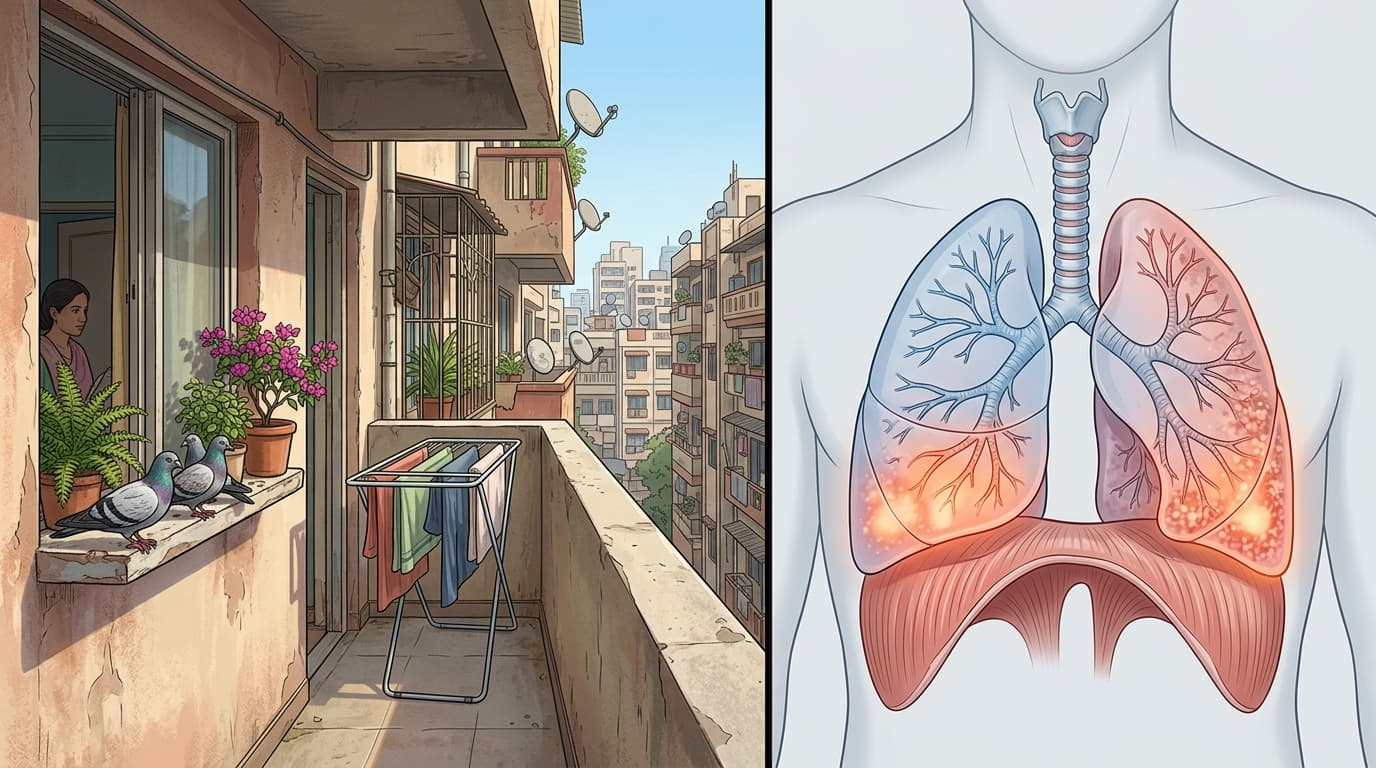
You do not have to keep birds to develop a bird-related lung disease. Feeding pigeons from a balcony every morning, over several years, can provide enough exposure to cause permanent scarring in the lungs.
This condition is called hypersensitivity pneumonitis. When birds are the trigger, it is often known as bird fancier's lung. It is not rare in Indian cities, where pigeon populations are large and balcony feeding is common and culturally routine. It is, however, frequently missed — because the symptoms look like a dozen more ordinary things.
What is hypersensitivity pneumonitis?
Hypersensitivity pneumonitis is an immune reaction in the lung tissue itself, not in the airways. The immune system reacts to something inhaled repeatedly — most commonly bird proteins or certain moulds — and that reaction causes inflammation deep in the lung.
This is important, because it makes the condition different from asthma. Asthma affects the airways and responds to inhalers. Hypersensitivity pneumonitis affects the lung tissue where oxygen crosses into the blood, and inhalers do not fix it.
If the exposure stops early, the inflammation can settle and the lung can recover. If the exposure continues for years, the inflammation gradually converts to fibrosis — permanent scarring. Scarred lung does not heal. That is the whole reason this condition matters so much: it is one of the few causes of lung scarring that is entirely preventable, but only if it is identified before the scarring sets in.
Where the exposure actually comes from
The obvious source is keeping birds — pigeons, parrots, parakeets, budgerigars, cockatiels. Breeders and racing pigeon keepers are the classic high-risk group.
But the exposure that causes problems in Indian homes is usually far less obvious:
- Feeding pigeons at a window, balcony or terrace on a daily basis
- Pigeons nesting on an air conditioner unit, ledge or in a disused balcony corner
- Accumulated droppings and feathers on balconies and window sills
- Dried droppings on AC outdoor units, which then blow fine particles into the flat
- Feather pillows and quilts, in some cases
- A neighbour's bird cage on a shared balcony or airshaft
The common thread is that the particles are fine, dry and inhaled without you noticing. Dried droppings crumble into dust. Sweeping them dry sends that dust directly into the air you breathe.
What it feels like, and why it gets missed
The symptoms of hypersensitivity pneumonitis are frustratingly ordinary and frequently mistaken for common respiratory ailments:
- A dry cough that does not clear up after standard treatment
- Breathlessness that appears first on stairs or on an incline, then on flat ground
- Tiredness, reduced stamina, and general fatigue
- Sometimes low-grade fever or unexplained weight loss
- In some people, Symptoms that improve on holiday or away from home and return upon coming back
That last pattern is a significant clue and is often the clinical detail that unlocks the diagnosis. If your breathing is noticeably better when you spend a week away from your flat, that is worth mentioning to your doctor.
The reason this condition is so often missed is that the early picture looks like a simple chest infection, and later it looks like ageing or being out of shape. Patients are commonly treated with repeated courses of antibiotics, or told they need to lose weight and exercise more. Months pass while scarring progresses quietly in the background.
Persistent breathlessness that is slowly getting worse should not be attributed to poor fitness without investigation. Being unfit does not usually produce a persistent cough. It does not usually get steadily worse over months. And it does not show up on a CT scan.
How it is diagnosed
Diagnosis depends heavily on one thing that costs nothing: a careful exposure history. If a doctor never asks about birds, the diagnosis is very easy to miss — which is why it is worth volunteering the information yourself.
Tell your doctor about any bird exposure, even if it seems trivial. Feeding pigeons twice a week counts. Pigeons nesting outside the bedroom window counts.
Beyond the history, clinical assessment typically involves:
- High-resolution CT (HRCT) of the chest: Shows characteristic ground-glass changes, mosaic attenuation, and whether fibrotic scarring has already developed.
- Pulmonary function tests including DLCO: Measures how efficiently oxygen crosses from lung air sacs into the bloodstream — often the earliest physiological abnormality.
- Blood tests for avian antibodies: Precipitating antibodies against pigeon or parrot antigens support the diagnosis, though they are not conclusive on their own.
- Bronchoscopy with bronchoalveolar lavage (BAL), or transbronchial cryobiopsy: Performed in selected cases when the diagnostic picture remains unclear.
What to do about it: Prevention and exposure control
If hypersensitivity pneumonitis is confirmed, medication has a role — but removing the exposure is the single factor that determines the outcome. Steroids can calm active inflammation, but they cannot overcome continued daily antigen exposure.
Practical steps that make an immediate clinical difference:
- Stop feeding pigeons at windows, balconies and terraces. This is the single most effective measure.
- Clear droppings and feathers regularly from balconies, window ledges and air conditioner units.
- Never dry-sweep droppings. Always dampen the area first so dried particles do not become airborne. Wear an N95 mask while cleaning.
- Block nesting sites with balcony netting and protective covers around outdoor AC units.
- Keep bird enclosures away from living and sleeping quarters, cleaning cages with protective respiratory masks.
- Consider whether other household members have similar symptoms from shared environmental exposure.
When to see a pulmonologist
Seek specialist assessment if you or a family member experience:
- A cough lasting more than three to four weeks that has not responded to standard treatment
- Breathlessness that is gradually worsening over weeks or months
- Breathing difficulties alongside regular domestic or environmental bird exposure
- A chest X-ray or CT showing shadowing, ground-glass opacity, or scarring
- Symptoms that improve away from home and return upon return
The value of seeing a specialist early is straightforward: Early hypersensitivity pneumonitis is often completely reversible. Late hypersensitivity pneumonitis is fibrosis, and fibrosis is permanent. The interval between those two states is where the entire outcome is decided.